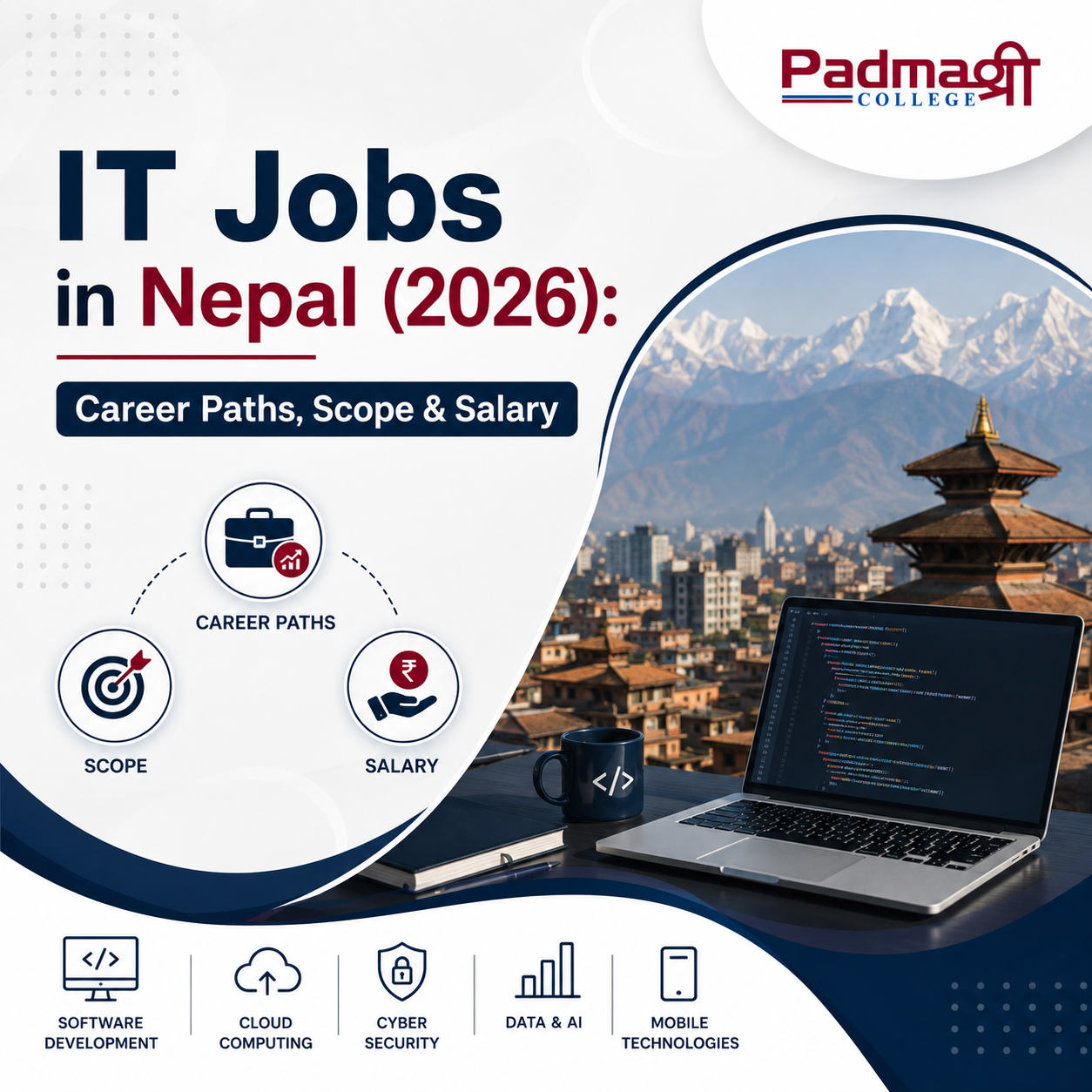
Why IT is Booming in Nepal (2026): A Guide to BIT Salaries & Top 10 Careers


If you have just finished +2 and you are wondering whether IT is really worth pursuing in Nepal the numbers in 2026 give you a very clear answer. Nepal's IT sector is no longer a "future opportunity." It is the present. Exports are nearing USD 1 billion, around 100,000 professionals are already working in the industry, and hiring across software development, AI, cybersecurity, and cloud is growing faster than any other white-collar field in the country.
This guide breaks down exactly why IT is booming in Nepal, what the job market data for 2026 actually shows, the realistic salary you can expect, and the career paths open to you as a student starting today. Everything here is sourced from current industry reports, employer data, and on-the-ground hiring trends not hype.
Quick summary: Nepal's IT industry is growing at roughly 18–20% annually, has crossed the USD 1 billion export mark, and analysts project up to 500,000 tech-enabled jobs within a decade. For a +2 graduate, this is the best time in Nepal's history to enter IT and a Bachelor of Information Technology (BIT) or BCA degree is the most direct entry route.
The numbers are not small anymore. According to industry leaders at the Nepal Association for Software and IT Services (NAS-IT), Nepal's IT exports have approached the USD 1 billion mark in 2025–26, growing at around 20% annually from the USD 515 million figure recorded by IIDS in 2022.
Here is what that growth looks like in plain terms:
|
Indicator |
2022 |
2026 (Estimated) |
|
IT/ICT Exports |
~USD 515 million |
~USD 900 million – USD 1 billion |
|
People Employed in IT |
~70,000 |
~100,000+ |
|
Annual Growth Rate |
— |
~18–20% per year |
|
Projection (10-year) |
— |
Up to 500,000 jobs |
|
Companies Affiliated with NAS-IT |
— |
80+ active member firms |
|
% of IT employment in Kathmandu |
— |
~90% |
To put that in perspective: when a sector is growing at 18–20% a year, the number of jobs roughly doubles every four years. There are very few industries in Nepal — possibly none — with that kind of compounding curve right now.
This isn't a coincidence or a temporary spike. There are concrete structural reasons behind the boom. Understanding them will also help you choose the right specialization later.
Companies in the United States, Australia, the UK, Japan, and Europe are actively outsourcing software development, healthcare data analytics, home loan processing, and IT support to Nepali firms. Australian home loan processing alone employs thousands of Nepalis through more than a dozen companies. US healthcare data analytics is another fast-growing cluster, and AI-services companies like Fusemachines have built international reputations from Kathmandu.
The reason is simple: Nepali engineers deliver English-fluent, technically strong, time-zone-friendly work at competitive cost. That value proposition is not going away.
Before COVID-19, getting an international IT job almost always meant leaving Nepal. Today, remote employment is the new normal. Platforms like Upwork, Toptal, Arc, and direct full-time remote contracts mean a developer in Tinkune or Pokhara can earn in USD or AUD without ever leaving home.
This is the single biggest game-changer for Nepali IT graduates. A senior developer working remotely for a US firm can earn NPR 200,000 to 500,000+ per month — multiples of what a local salary pays — while supporting their family in Nepal.
Nepal's government has formally declared the IT Decade (2081–2091 BS / 2024–2034 AD) with explicit targets for IT exports, employment, broadband infrastructure, and digital services. The Digital Nepal Framework, the Nagarik App, e-governance projects, and tax incentives for IT firms are all moving in the same direction: making Nepal a digitally-driven economy.
For a student, this means government departments, banks, hospitals, schools, and public institutions are actively hiring IT staff — not just private companies.
Companies like F1Soft, eSewa, Khalti, Daraz, CloudFactory, Leapfrog, Verisk Information Technologies, Deerwalk, Cotiviti, Cedar Gate, Javra Software, Fusemachines, and Incessant Rain have created an entire generation of high-paying tech jobs. Nepal's e-commerce industry has been growing at over 40% per year, fintech is digitizing every payment from mom-and-pop shops to remittance, and edtech and healthtech startups are raising real funding.
Each of these requires developers, testers, designers, data engineers, DevOps specialists, and product managers.
A growing number of Nepali professionals who studied or worked in the US, Australia, the UK, and Singapore are returning to Nepal to start tech-enabled companies. They bring international standards, foreign clients, capital, and management practices. Firms like SumX and K&A Engineering — founded or led by returnees — now employ hundreds of Nepalis serving global clients. This trend is creating high-quality jobs that didn't exist a decade ago.
Let's get into the actual numbers. The figures below are compiled from current job-portal data (Merojob, KumariJob, Necojobs), salary surveys (PayScale, Glassdoor, Levels.fyi), and industry reports.
|
Career Level |
Years of Experience |
Monthly Salary (NPR) |
Annual Salary (NPR) |
|
Intern / Trainee |
0 (during BIT/BCA) |
10,000 – 20,000 |
1.2 – 2.4 lakh |
|
Fresher / Junior Developer |
0 – 2 years |
25,000 – 50,000 |
3 – 6 lakh |
|
Mid-level Engineer |
2 – 5 years |
50,000 – 1,20,000 |
6 – 14 lakh |
|
Senior Engineer / Tech Lead |
5+ years |
1,00,000 – 2,50,000 |
12 – 30 lakh |
|
Cloud Architect / AI Specialist |
6+ years |
1,50,000 – 3,50,000+ |
18 – 42 lakh+ |
|
Remote (US/EU/AU clients) |
2+ years |
2,00,000 – 5,00,000+ |
24 – 60 lakh+ |
For context, the average salary in Nepal across all industries is around NPR 25,000 to 40,000 per month. So even a fresher IT job typically pays at or above the national average — and the ceiling is dramatically higher.
Based on current market data, these are the roles commanding the best pay:
About 90% of Nepal's IT employment is concentrated in Kathmandu, particularly in tech corridors around Kathmandu Valley including Tinkune, Sanepa, Kupondole, Lazimpat, and Sifal. This is one reason why studying at a Kathmandu-based college — rather than relocating later — gives you a major head start through internships, networking, and walk-in interviews.
If you are starting your BIT or BCA, here are the realistic career routes you can choose from. Most students don't pick on day one you'll discover what fits during your degree through projects and internships.
The default path. You'll build websites, mobile apps, business software, and internal tools. Most BIT/BCA graduates start here. Highest demand, easiest entry, biggest local job market.
Front-end (React, Vue, Next.js) plus back-end (Node.js, Laravel, Django). Full-stack developers are the most in-demand profile in Nepal in 2026 because they can work across the whole product. Outsourcing firms specifically hire for this skill set.
Flutter is the dominant cross-platform framework in Nepal. Native (Kotlin for Android, Swift for iOS) is also valued. Every fintech, edtech, and consumer startup needs mobile developers.
Banks, telcos, insurance companies, and analytics outsourcing firms (think US healthcare data) all need people who can clean, analyze, and visualize data. Python, SQL, and Power BI/Tableau are the core stack.
The most futuristic and the highest-ceiling career. Requires strong math foundations and Python/TensorFlow/PyTorch skill. Fusemachines, Cotiviti, and similar firms hire AI talent locally and internationally.
With banking, government, and corporate digitization, cyber threats have multiplied. Ethical hackers, SOC analysts, and security auditors are in short supply — and well-paid.
AWS, Azure, GCP, Docker, Kubernetes, CI/CD pipelines. Every modern company needs someone to manage cloud infrastructure. Often the highest-paid role in mid-sized firms.
The visual and experience side of products. Combines creativity with logic. Booming alongside fintech and SaaS in Kathmandu.
Manual and automated testing. Often the easiest entry point for freshers. Many move into developer or DevOps roles after 1–2 years.
Technically not "IT engineering," but the demand is exploding. Many BIT/BCA graduates with a marketing aptitude end up earning very well in this hybrid field.
A degree gets your CV looked at. Skills get you the job. The Nepali IT market in 2026 hires on demonstrable ability, portfolio, and projects — not just on the certificate.
Every employer in Nepal lists the same gaps when hiring freshers: English communication, problem-solving thinking, teamwork, time management, and continuous learning attitude. These often matter more than a marginal difference in coding skill — especially for outsourcing firms whose work involves daily client communication with US, Australian, or European clients.
Here is the realistic sequence that works for most successful Nepali IT professionals today:
The two main routes are BIT (Bachelor of Information Technology) and BCA (Bachelor of Computer Application). Both are 4-year programs and both lead to the same career paths. Some students also pursue BSc CSIT, which is more research/engineering-focused.
→ Read more: BIT vs BCA in Nepal: Which Should You Choose? (Complete Guide)
Don't wait until graduation. Start with simple websites in your first semester. Move to full-stack apps by your second year. Contribute to GitHub. Build a portfolio. A BIT student with 5 real projects on GitHub gets hired faster than one with a 4.0 GPA and no projects.
Internships are how 80% of Nepali IT freshers get their first full-time job. Every reputable IT college — including Padmashree — has industry tie-ups for internship placement. Aim for at least one summer internship by your third year.
By the time you reach the third year, you'll naturally lean toward something front-end design, back-end logic, data, security, or mobile. Double down on that area.
Use Merojob, KumariJob, LinkedIn, and direct applications to companies like Verisk, Cotiviti, F1Soft, Leapfrog, CloudFactory, eSewa, Khalti, Deerwalk, and Fusemachines. Many of them have campus-recruitment drives at colleges in Kathmandu.
You'll hear the argument that "degrees don't matter, only skills do." That is partly true but partly misleading.
Here is what a Bachelor's degree actually gives you that pure self-study cannot:
The smart move is degree PLUS skills, not one or the other.
Padmashree College, located at Raja Janak Marg, Tinkune, Kathmandu, has been training Nepal's IT and management talent since 2007. Our IT programs are designed specifically for the kind of careers and salaries discussed in this article.
Admission for the 2026 intake is now open. Visit our Tinkune campus or call +977-1-4112252 / +977-1-4112057 to speak directly to our admission counselors. Walk-ins welcome Sunday through Friday.
Yes. Nepal's IT sector exports are nearing USD 1 billion, employment has grown from ~70,000 to 100,000+ in four years, and the industry is growing at roughly 18–20% annually. Industry projections point to 500,000 tech-enabled jobs in Nepal within a decade.
A fresh BIT or BCA graduate typically earns between NPR 25,000 and NPR 50,000 per month in their first job, depending on skills, projects, and the company. With 2–5 years of experience, this typically rises to NPR 50,000 – 1,20,000+ per month.
Cloud Architects, AI/ML Engineers, and Cybersecurity Specialists lead the salary charts, with senior professionals earning NPR 1,50,000 to 3,50,000+ per month. Remote work for international clients can push earnings to NPR 5,00,000+ per month.
Both lead to the same career outcomes. BIT (typically foreign-affiliated, like Padmashree's Nilai University BIT) suits students who want an international curriculum, direct admission, and global pathways. BCA (Tribhuvan University) suits students who prefer a TU-recognized degree and don't mind sitting the BCA entrance exam. We've written a full BIT vs BCA comparison guide to help you decide.
Absolutely. With remote work, freelancing platforms, and Nepal's growing outsourcing sector, you can earn international-level income while based in Kathmandu, Pokhara, or anywhere with stable internet. Many Nepali developers earn NPR 2,00,000 – 5,00,000+ per month working remotely for foreign clients.
No. Nepal's IT industry is mature enough in 2026 that a strong BIT or BCA from a reputable Kathmandu college, combined with good projects and internships, gives you the same career options as a foreign degree — at a fraction of the cost. Many Nepali graduates from local colleges are now earning more than their foreign-educated peers.
Start with JavaScript, Python, HTML/CSS, and Git. Then add a front-end framework (React) and a back-end framework (Node.js or Laravel). After that, pick a specialization — cloud (AWS), mobile (Flutter), AI (Python ML), or cybersecurity — based on what genuinely interests you.
Padmashree College is located at Raja Janak Marg, Tinkune, Kathmandu, near Koteshwor and Tribhuvan International Airport. Reach us at +977-1-4112252 or visit padmashreecollege.edu.np.
If you are reading this in 2026 as a +2 graduate, you are entering Nepal's IT industry at the best possible moment in its history. The infrastructure exists, the companies are hiring, the salaries are real, the international opportunities are wide open, and the government is actively backing the sector.
What you choose to do in the next four years which degree you pick, which projects you build, which internships you take, which skills you develop will determine whether you ride this wave or watch it pass.
We'd love to help you ride it.
Ready to start your IT career? Apply for BIT or BCA at Padmashree College for the 2026 intake.
📍 Raja Janak Marg, Tinkune, Kathmandu
📞 +977-1-4112252 / +977-1-4112057
--semester-wise-overview.png)
BIT Syllabus & Subjects in Nepal (2026): Semester-wise Overview
BIT Syllabus & Subjects in Nepal (2026): Semes ....png)